Why service, not the day, is the unit of a restaurant rota
Most scheduling tools think in days. A restaurant thinks in services, and the two rarely line up. Lunch and dinner can need different numbers of people, different positions and different skill mixes, and they often sit either side of a gap where the room is empty and nobody should be paid to stand in it.
Building the week by day flattens that. You end up with a headcount that is roughly right across twelve hours and precisely wrong across both services inside them. Setting cover per daypart keeps the two apart, so a Friday dinner that needs a second section server does not borrow that person from a lunch that never needed them. It also makes the labour line readable afterwards, because cost rolls up against the service that incurred it rather than the calendar day that contained it.
There is a second benefit that only shows up later. When the week is built per service, the question of who was on when a Saturday went wrong has an answer, and so does the question of whether the extra person on Thursday lunch was ever needed. A rota built by day cannot answer either without somebody reconstructing the shift from memory.
The split shift problem, and how to make it survivable
Split shifts exist because demand does. The mistake is not scheduling them, it is scheduling them to the same people every week and pretending the day is two short shifts rather than one long one.
Two things make them tolerable. The break has to be long enough to be worth going home for, because a ninety-minute gap is not a break, it is unpaid waiting. And the burden has to rotate, which only happens if somebody can see who carried it last time. Formclock shows both halves on one row, so the real span of the day is visible while you are building the week rather than discovered by the person working it.
It is also worth being clear that a split is one long day, not two short ones, wherever rest rules are concerned. The gap between the two halves is not rest in the sense the regulations mean, and the clock that matters for the next morning starts when the second half ends. Building the week with that in view stops a split from quietly creating a rest breach the following day.
What a call-out an hour before service actually costs
The cost is rarely the shift. It is the twenty minutes of phoning around, the person who says yes because they always say yes, and the compliance problem you create by putting somebody on their fourth consecutive close.
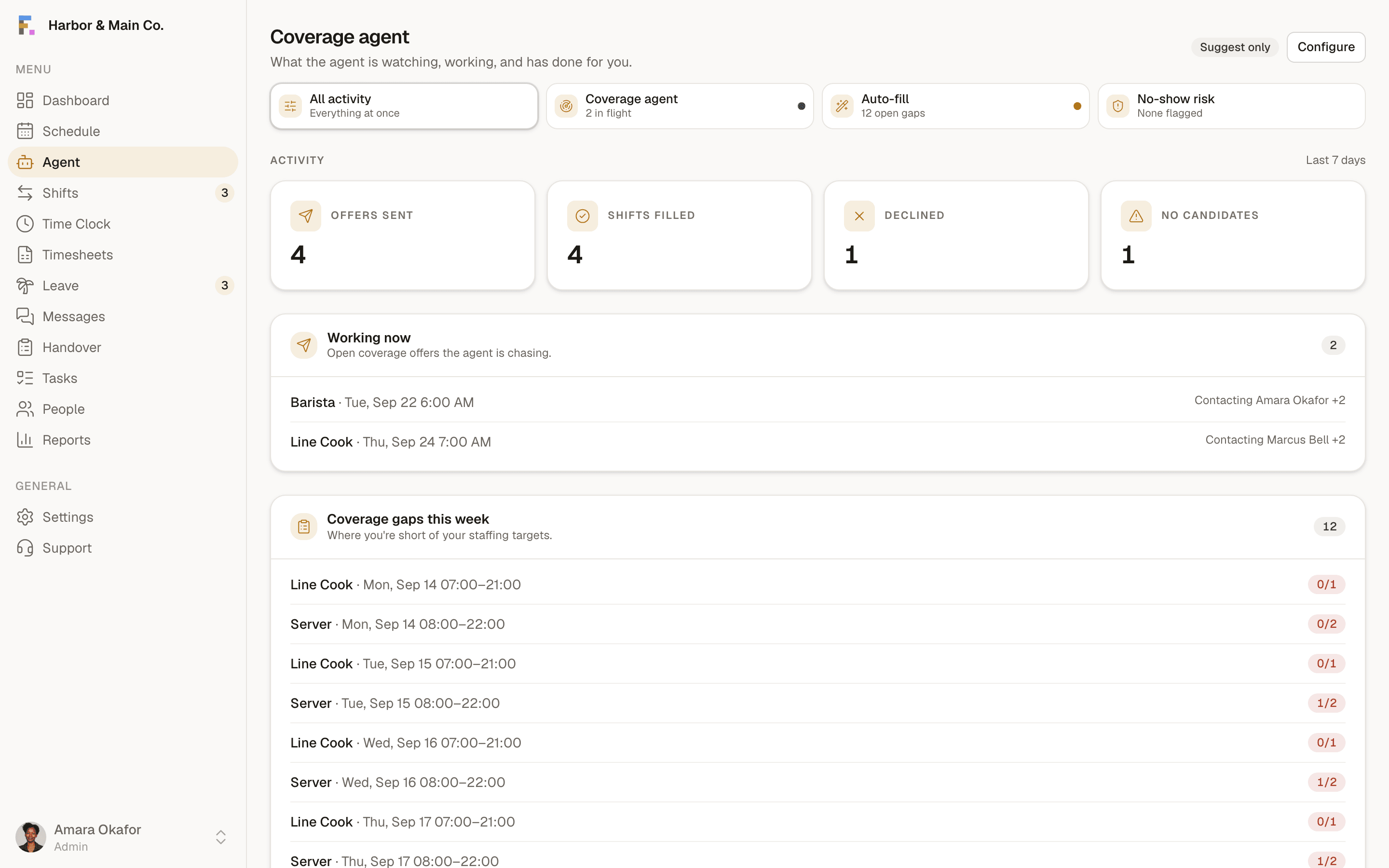
Ranking the available people against position, availability and the rules that would block them turns that into a decision rather than a scramble. The part that matters is the explanation: knowing why somebody came top is what lets you overrule it sensibly, and what lets you answer the person who asks why they got called again. Every action the agent takes is logged and reversible, which is the difference between automation you can defend and automation you have to trust.
Speed comes from asking the right people rather than asking everybody. A ranked list of who is qualified for the position, free at that hour and not already near their weekly hours turns a scattergun round of messages into one or two accurate asks. It also leaves a record of who was offered the shift, which matters the next time somebody says they are never asked.
Tipped shifts, and who quietly gets every good Friday
In a tipped house the shifts are not worth the same to the people working them. A Friday dinner in a busy section and a Tuesday lunch pay the same hourly rate and land very differently in somebody's week, and everybody on the floor knows exactly which is which.
That makes the allocation of the good shifts a fairness question whether or not anyone is treating it as one. Left to habit it settles on whoever is easiest to reach and most willing to say yes, and the people who lose out rarely raise it before they leave. Tracking how the desirable shifts have been shared out over recent weeks, and letting that weigh on who gets offered the next one, turns a thing managers were doing by feel into something they can point at when asked.
None of this requires publishing anybody's earnings. It requires only that the allocation of shifts is visible and has a stated reason behind it. A team that can see how the desirable shifts have moved around over a month argues about them far less than one where the pattern is real but undiscussable.
Front and back of house do not fail in the same way
A server short is a problem you find out about during service and can partly absorb by moving sections. A cook short is a problem that started at prep, hours before anybody sat down, and no amount of goodwill at seven closes it.
Rotas that treat the two as one pool of bodies get this wrong in both directions. They over-cover the floor because the shortfall there is visible, and under-cover the pass because the shortfall there is not, at least not until the tickets back up. Setting cover separately per position, and treating the kitchen's lead time as part of the shift rather than as goodwill before it, keeps the two failures apart. It also stops a swap that looks harmless on the floor from removing the only person who can work the grill.
Swaps are where this most often goes wrong. A swap between two servers is usually fine, and a swap that quietly removes the only person on shift qualified to work the grill is not, even though both look identical as a request in a message thread. Checking the position rather than the headcount at the point the swap is approved is what keeps the two apart.