Certifications are a scheduling constraint, not a filing exercise
A forklift certificate kept in a folder is a compliance record. The same certificate attached to a position is a scheduling rule, and only the second one prevents anything. The distinction matters because the failure is not usually somebody with no certificate, it is somebody whose certificate lapsed and who nobody re-checked.
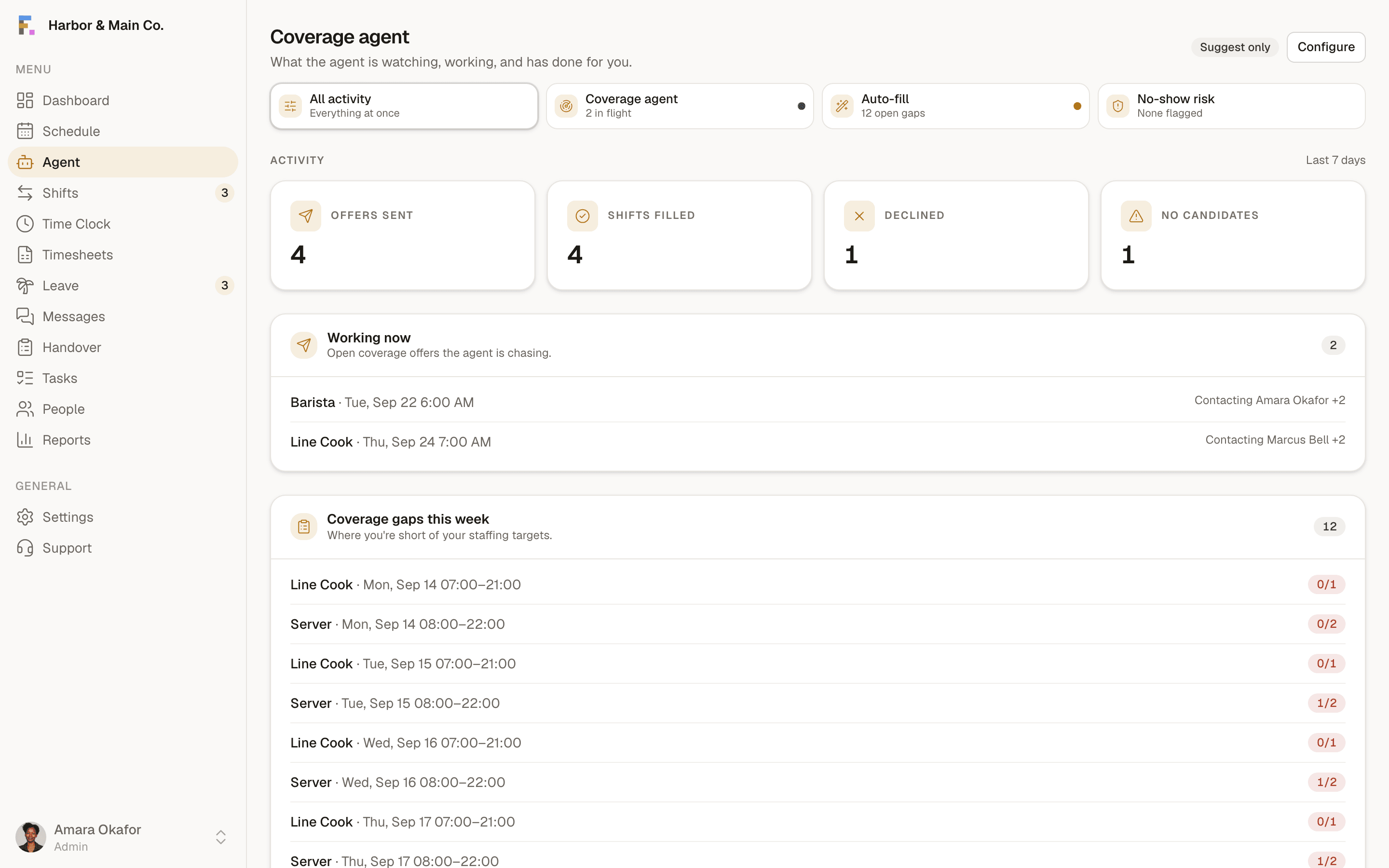
Requiring a current certification on the position means the check runs on the expiry date rather than on whether it was ever issued. Somebody past it stops being offered for that work, including when the coverage agent is filling a gap unattended. That last part is the one worth insisting on: automation that ignores the constraint is worse than no automation, because it acts faster than the person who would have noticed.
The date that matters is not the expiry, it is the date you need to have started doing something about it. A certification lapsing in three weeks is a retraining booking; the same certification lapsing tomorrow is a hole in the rota. Warning ahead of the expiry rather than on it is the whole difference between the two, and it costs nothing to set.
Rotations drift when they are copied by hand
Four-on-four-off, continental, and the various night patterns all look simple on paper and all decay the same way. Somebody copies last cycle forward, a shift gets nudged for a holiday, and eight weeks later the pattern no longer matches the one the team agreed to.
Expressing the rotation as a recurrence rather than retyping it each cycle removes the copying step, and with it the drift. Nights crossing midnight are stored in UTC against the site timezone, so a shift running to seven in the morning lands on the day it belongs to rather than being split across two in reports. Miscounted night hours are hard to spot precisely because the rota looks right.
Generating the pattern from its rule rather than copying last week has a second effect that matters more over time. Exceptions stay visible as exceptions. When somebody swaps out of a night, that is a change against a known pattern rather than a new fact in a grid that has been hand-edited so many times nobody can say what the pattern was supposed to be.
Overtime you planned for, and overtime you discovered
These cost the same money and are completely different problems. Planned overtime is a decision about throughput. Discovered overtime is a decision somebody else made on your behalf, usually by covering a gap on a Thursday, and you learn about it once it is unchangeable.
Checking the threshold your organisation has set while the week is still being built moves the discovery earlier, to the point where a shift can still be moved or split. It does not make overtime cheaper. It makes it a choice, and it stops the pattern where the same few people quietly absorb every gap because nobody was watching the running total.
The threshold that decides which is which belongs in one place. Once it is a setting rather than a number in somebody's head, the warning appears while the week is still being built, when moving four hours costs nothing, instead of appearing in the payroll run, when it costs exactly what it costs.
Volume moves week to week, and the rota was set before it did
Pick volume is not steady. It responds to promotions, to a customer's own peak, to a delayed container, and most of those become known after the rota has gone out. A fixed headcount is therefore right on the average week and wrong on the ones that matter.
The practical answer is not to publish later, which costs the team the notice they need, but to publish a plan that can absorb a change without being rebuilt. That means cover defined per area so a volume change lands where it belongs, a clear picture of who is available and under their hours before anybody is asked, and a record of what changed after publication. A rota that can be adjusted and explained is worth more than one that was theoretically optimal on the day it was written.
Notice is the constraint that makes this hard, and it should be. Staff who get their week late plan their lives late. The workable compromise is to publish on time and treat later changes as changes, recorded and visible, rather than to hold the rota back until every unknown has resolved. One of those preserves the team's notice and the other quietly spends it.
The dock, the pick face and being short in only one of them
A site is rarely short of people in general. It is short at goods-in on a morning with three deliveries booked, or short on the pack bench when a large order lands, while another area is comfortable.
A single site-wide headcount cannot see that. It reports a full shift and the floor experiences a queue. Defining cover per area and per position means the shortfall shows up where it will actually happen, and it makes the redeployment question explicit rather than improvised: who on shift is trained for the area that is short, and what does moving them do to the area they are leaving. That is a decision worth making deliberately, because the second half of it is the part usually discovered afterwards.
Redeployment is only an option if you know who can be redeployed. A list of which people on the current shift are trained for goods-in, for the pack bench and for the mezzanine is the thing that turns a shortfall into a decision instead of into a supervisor walking the floor asking. It is also the list that tells you where the next round of cross-training would do the most good.